
The Project Approach is a curriculum similar to Units but in much more depth. The project is selected based on the children's interests and takes it's course according to the children's interest's. A project usually lasts four to eight weeks and is broken into three phases. To learn more about this method go to the "Project Approach" website.
The Mammal Project
The Blue Room settled on a project about Mammals by first brain storming ideas, and then narrowing them down with secret ballots.
Phase I
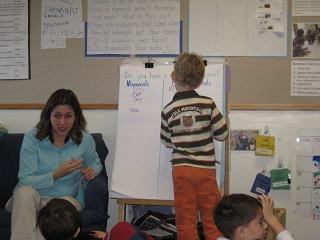
In this phase the children discuss and make charts about what they already know, or think they know about mammals. From these discussions the teacher can assess where each of the children are in their knowledge.
Next the children thought about what they would like to find out about mammals. This be list is revisited because when they delve into the subject they may discover other questions to be answered.
Phase II
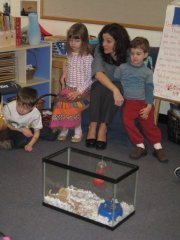 This is the investigation portion of the project. Many methods are used to learn and answer questions that arise. By this time, after using the Project Approach since they were three, the children are able to identify the sources that they can use to study Mammals. Some of these sources are computers, books, interviewing experts, and first hand observations.
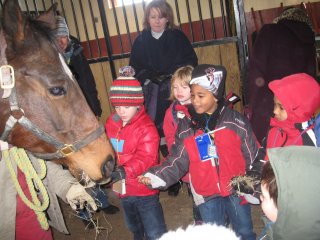
Some of the highlights of the Blue Room Mammal Study have been visits from families with their pet gerbils and dogs. A visit from a biologist from the University of Maryland who shared her mammal skulls etc. The kindergarteners also took a trips to the campus farm to learn about cows, horses and sheep, a field trip to the College Park Animal Hospital to have their guinea pig Cinnamon Sugar checked and a visit to the Brookside Gardens Nature Center to learn about mammals in Montgomery County.
This is the investigation portion of the project. Many methods are used to learn and answer questions that arise. By this time, after using the Project Approach since they were three, the children are able to identify the sources that they can use to study Mammals. Some of these sources are computers, books, interviewing experts, and first hand observations.
Some of the highlights of the Blue Room Mammal Study have been visits from families with their pet gerbils and dogs. A visit from a biologist from the University of Maryland who shared her mammal skulls etc. The kindergarteners also took a trips to the campus farm to learn about cows, horses and sheep, a field trip to the College Park Animal Hospital to have their guinea pig Cinnamon Sugar checked and a visit to the Brookside Gardens Nature Center to learn about mammals in Montgomery County.
Phase III

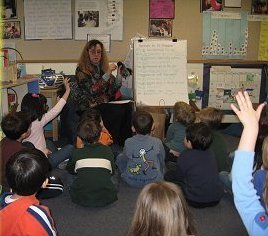
After the children studied mammals for many weeks, and the questions they had were answered, the interest started to wane. This is the third phase where the children decide how to showcase the knowledge they have gained. This could be in the form of a book, a museum, a dramatization, an exhibit etc. After a discussion the children voted and decided on a habitat exhibit. The children were divided into groups representing eight different habitats. Each group worked on creating a habitat and mammals out of miscellaneous materials. For the exhibit they arranged the habitats out in the hall and wrote labels and descriptions for each one. The grand opening was announced via posters made by the kindergarteners. The day of the exhibit the kindergarteners stood in front of their habitat to answer any questions as parents and other students came by to examine the display. This showcased the knowledge that was acquired over the 3 month investigation of mammals.